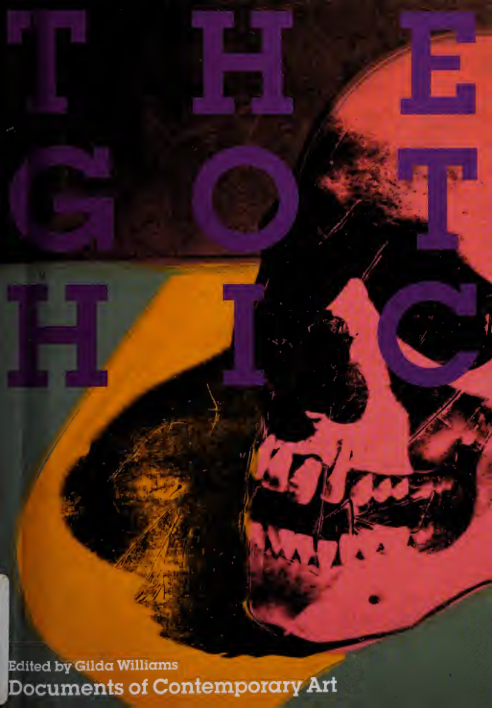
The Gothic
The Gothic
Next highlight
Highlights
John Ruskin, The Stones of Venice, 1853
‘Gothic’ is a borrowed term in contemporary art, applied liberally to artworks centring on death, deviance, the erotic macabre, psychologically charged sites, disembodied voices and fragmented bodies.
Louise Bourgeois’ Cells
-
- View Highlight
- My note: Cool like saw esque cages
dimly lit, inaccessible spaces, phantom bodies, loaded objects and body fragments populate a forbidden world steeped with the artist’s memories of an unhappy childhood centring on her overbearing father.
Like a Gothic novelist, the artist sets the scene in an unfamiliar and frightening place; the ghost of young Bourgeois occupies the Cells like the virginal female trespasser of so many Gothic novels
Bourgeois’ Cells moreover enact what literary critic Anne Williams considers the core of the Gothic narrative: ‘Gothic plots are family plots; Gothic romance is family romance’
Paul McCarthy’s disturbing, mechanized sculpture Cultural Gothic (1992),
-
- View Highlight
- My note: Fucked up uncanny mannequins, dad teaching son zoophilia
Cultural Gothic is aptly titled in so far as it performs another standard Gothic theme, i.e., the revelation of an unspeakable family ‘curse’ by a curious innocent
Charles Ray’s Family Romance (1993) is a sculpture of a father, mother, young son and toddler daughter all monstrously reaching exactly the same height.
diminishing role of fatherhood, a theme also central to Gothic literature and exemplified in Anne Radcliffe’s The Italian (1797).
Gothic literature foregrounded the symbolic rather than biological role of paternity, it has been credited with pre-empting concepts later formalized in Lacanian psychoanalysis as the
Banks Violette’s sculptural installations
-
- View Highlight
- My note: crashed chandelier
David Altmejd’s werewolves and glitter Goth
-
- View Highlight
- My note: AWESOME kinda mannequin sculptural stuff
t Gregor Schneider’s labyrinthine architectural installations cross the Gothic love for haunted houses and uncharted dungeons with a film noir scene-of-the-crime.
-
- View Highlight
- My note: incredible interiors
Gothic contemporary art is principally Anglo- Saxon, with a sprinkling of excellent examples from continental Europe as well; however there is also a Latin American, arguably Catholic strain which
-
- View Highlight
- My note: teresa exploring morgues
large-scale, painterly colour photographs of corpses, the Morgue series (1992-).
precedents
-
- View Highlight
- My note: old classic examples
Whilst all the artists listed here traffick in Gothic themes - among them death, transgression, patriarchy, ruins, ghosts and the supernatural - it is important to bear in mind that the vast majority
(Douglas Gordon, Stan Douglas, Banks Violette
-
- View Highlight
- My note: artists that claim gothic
the majority in this collection in no way actively claim such a lineage.
Even the most Gothic artist here (my vote would have to go to the incomparable, death-obsessed Damien Hirst, who even purchased his very own ‘Strawberry Hill’, the neo-Gothic Toddington Hall, to
-
- View Highlight
- My note: corpses in water tanks
‘Gothic’ in contemporary art is necessarily a partial term which serves mostly to identify a peculiar, dark sensitivity shared by the artist and the observer who has chosen to respond to the work in
Although the themes in contemporary Gothic art are grounded in late eighteenth- and nineteenth-century Gothic literature, they are today combined unselfconsciously with, among other things,
Such imprecision in no way damages the term, but in fact contributes to making it so evocative and resilient, enriching the discussion around artists as different as Andy Warhol, Janet Cardiff, Paul
Lost in this twenty-first-century usage of the term is the Ruskinian equivalence of ‘Gothic’
with ‘non-classical’, or the elongated stone figures and soaring cathedrals of the Middle Ages
medieval churches with their towers and flying buttresses frosted with cerulean crystals)
Goya’s blood-soaked caprichos
-
- View Highlight
- My note: vampirism and blood sucking
‘Gothic’ in contemporary art is more atmospheric than neatly defined.
anti-intellectual and unscientific
The Gothic is a studied, adopted stance, whereas the uncanny is more an accident of the unconscious. If the uncanny is Freudian, then the Gothic is Lacanian.
Unlike the grotesque, the Gothic is aesthetic and seductive.
Roman Emperor Nero
-
- View Highlight
- My note: roman emperor known for cruelty and megalomania
Unlike the abject, the Gothic is cultured, sensual and affected. The abject is neglected, the Gothic refined; the abject is filthy, the Gothic merely cobwebbed and dusty. And not all horror is
Whilst the Gothic delights in trauma and terror, it asks for more than just straight, uncomplicated gore.
Always present in the Gothic is this: two things that should have remained apart - for example, madness and science; the living and the dead; technology and the human body; the pagan and the
American Gothic (1930) is such an effective title for Grant Wood’s austere portrait of that stiff Midwestern couple. Only the title masterfully suggests something sinister is afoot; it is nowhere in
The Gothic is anti-bourgeois and rejects such values as hard work, family, good cheer and common sense. Despite the sadist’s and the vampire’s exquisite manners, or the middle-class upbringing of the
Clarity and wholesomeness are by definition distant from the Gothic. It is anti¬ capitalist, furnished with un-bought heirlooms, and utterly antithetical to the packaging and the bright lights of the
It defies capitalism’s laws of real estate; spectacular, unrefurbished properties remain for centuries in the hands of unemployed vampires; castles spread tentacularly via dungeons and secret
-
- View Highlight
- My note: old property and those who inhabit it
The Gothic tends towards the dramatic, art-directed and excessive.
Jeff Wall or Gregory Crewdson
-
- View Highlight
- My note: photography that is eerie but not obvious
The Gothic is escapist, retreating into distant landscapes, lost eras and outlandish personal appearance. It celebrates depression as a kind of desirable, living death. This inclination to transcend
Jake and Dinos Chapman, Sue de Beer and Richard Hawkins indulge in teenage culture and behaviour; or that American horror film has an entire teen-flick sub-genre; or that the protagonist of American
Nevertheless, the Gothic can be as elaborate as Matthew Barney’s Cremaster cycle, or as subtle as Louise Bourgeois’ sophisticated, surrealist intertwining of sculptural form, autobiography and
-
- View Highlight
- My note: matthew barney high goth art